



How Crypto Staking Works and Where Its Yield Comes From
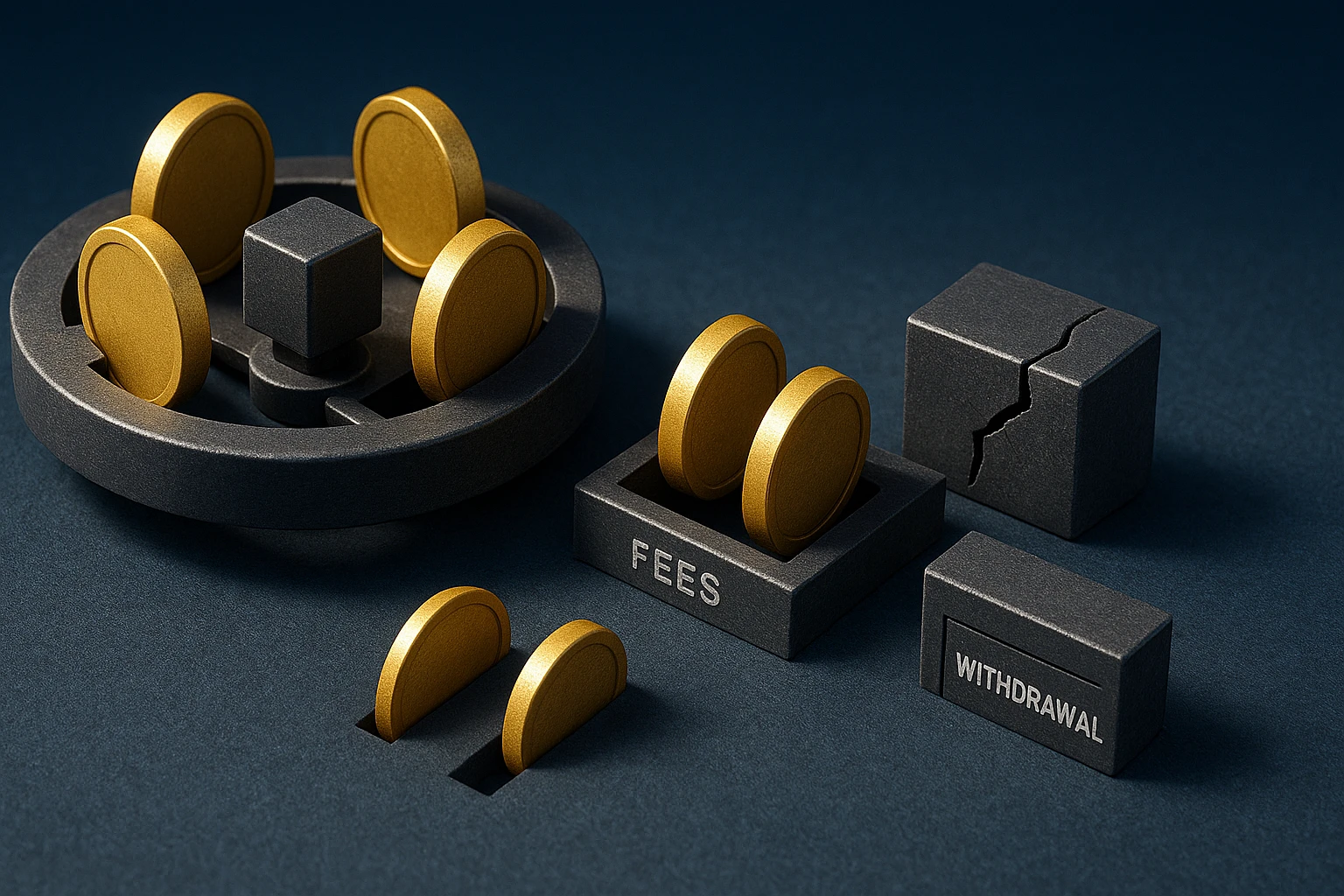


Crypto staking is a way to commit certain digital assets to the operation of a proof-of-stake blockchain. In return, a participant may receive rewards under that network’s rules. Those rewards are not interest paid by a bank, and staking does not create a fixed return. The amount, timing and even availability of rewards depend on the protocol, validator performance, network activity and the way a person stakes.
Understanding where a quoted yield comes from requires separating several things that are often bundled together: the blockchain’s consensus mechanism, the reward paid for helping secure it, the service used to stake, and any additional product layered on top. Each layer can add costs or risks. Staking can also leave a holder exposed to changes in the token’s market value even while rewards accrue.
What staking does on a proof-of-stake network
A proof-of-stake blockchain uses validators to help agree on which transactions are valid and what order they belong in. To qualify under the protocol, validators commit stake, usually in the network’s native token. The stake gives them an economic interest in following the rules: misconduct can lead to penalties, while successful participation may earn rewards. The details differ across blockchains, and not every cryptocurrency can be staked.
Some networks allow people to run validator software and stake directly. Others let token holders delegate stake to a validator without operating the infrastructure themselves. Delegation does not necessarily transfer ownership of the tokens, but the protocol and wallet determine what control the delegator retains and what actions are possible during a lockup. A delegated position can still be exposed to validator penalties, depending on the network’s rules.
Validators typically need reliable software, connectivity and correct operation. A protocol may select validators to propose or attest to blocks, or assign other duties that help the network reach agreement. A validator that performs its duties may qualify for rewards. Missing duties can reduce rewards or produce penalties. The protocol’s design determines how stake influences selection and what counts as good or harmful behavior.
Where staking rewards come from
There is no single source of staking yield across all networks. One possible source is newly issued tokens. A protocol can create and distribute tokens to validators and, where applicable, delegators as an incentive for securing the chain. This is sometimes described as an issuance or inflation reward. It is not revenue generated by an outside business. Issuance can increase the token supply, so a reward measured in tokens does not by itself show how a holder’s share of the network or purchasing power has changed.
Transaction fees can also contribute. Users pay fees to have transactions processed, and protocol rules determine how those fees are divided, retained or allocated. On some networks, validators receive some fee revenue; on others, the mechanism differs. Certain networks may also have proposer-related payments or other fee components. These are protocol-specific, and their size can change with network activity and rules. It is inaccurate to assume that every staking reward is funded by transaction fees or that fee income will remain steady.
In simplified terms, a participant’s gross reward may reflect their eligible stake, the total stake competing for rewards, the validator’s performance, the protocol’s reward formula and any eligible fees. A larger share of network stake does not necessarily mean a higher rate for every participant: many protocols distribute rewards across participants, and the rate can shift as the amount staked or the reward pool changes. Some networks also impose minimums, commission arrangements or other conditions.
Rewards may be displayed as an annual percentage rate, an annual percentage yield, or another estimate. These labels are not interchangeable in every presentation. A rate may assume rewards are automatically reinvested, or may show a simple annualized estimate without compounding. It may be shown before validator commission, service fees, network costs or taxes. Always check what the quoted figure includes, how it was calculated and whether it is historical, current or projected by the service. A displayed rate is not a promise of future rewards.
Why staking yields change
Staking rewards can vary because the protocol’s reward pool and the number of participating tokens change. If more tokens become eligible, a fixed or formula-based pool may be divided among more stake. If fewer tokens participate, the rate may change in the other direction, subject to the network’s design. Changes to issuance rules or validator economics can also alter rewards. Some protocols adjust incentives in response to network conditions, while others use different mechanisms.
Transaction-fee income can rise or fall with demand for block space, and it may be only one part of a validator’s compensation. Validator uptime, missed duties, commission and the participant’s timing can affect what is actually credited. A quoted network rate may therefore differ from the net amount received by a particular user. In addition, a reward paid in a token can have a different market value later. The token price may rise or fall independently of the number of tokens earned.
For these reasons, a staking rate is best understood as a changing protocol or service estimate, not a fixed interest rate. Comparing two percentages without checking their assumptions can be misleading. One may be gross while another is net, one may include compounding while another does not, or they may represent different lockup periods and risks.
Lockups, withdrawals and unbonding
Staking can limit access to tokens. Depending on the blockchain, a stake may be locked for a set period, remain unavailable until an unbonding process finishes, or be subject to withdrawal queues. Unbonding is the protocol process of removing stake; it can take time and may not begin instantly. During that period, the tokens may not be transferable or usable for another purpose. Exact conditions vary by network and by the staking method.
Some systems let users stake without a fixed lockup but still apply a withdrawal delay or other conditions. A service may also set its own operational rules. Before staking, check when withdrawal can be requested, how long it may take, whether rewards continue during the process, and whether delays can change when many participants exit. A token’s market price can move while it is inaccessible, so a lockup is both a liquidity constraint and a source of market exposure.
Slashing and other penalties
Slashing is a protocol-level penalty that can remove some staked tokens when a validator commits specified serious violations. Depending on the chain, examples can include signing conflicting messages or other behavior the protocol treats as provable misconduct. The precise triggers and penalty scale are network-specific. Slashing is not the same as an ordinary fall in the token’s market price, and it is not necessarily applied for every missed block.
Less severe operational problems may reduce rewards or cause smaller penalties rather than slashing. A validator’s mistake, poor infrastructure or malicious action may affect people who delegated to it, depending on the protocol. Delegation therefore does not eliminate validator risk. Users should understand how a network allocates penalties and whether a staking provider offers any protection. A provider’s statement about reimbursement is a separate contractual or service claim, not a change to the blockchain’s rules, and its terms and ability to pay matter.
Custody changes who controls the stake
With self-custody, a person controls the wallet keys used to authorize transactions, subject to the wallet and protocol. This can offer direct control over staking choices, but it also means the user must protect keys, check transaction details and understand the software being used. Losing access to keys or signing a malicious transaction can create losses unrelated to validator performance.
With custodial staking, an exchange or another provider controls the assets or the keys and handles staking operations. The service may make the process simpler, but users depend on its security, accounting, withdrawal policies and continued operation. They may have a claim against the provider rather than direct on-chain control of the staked position. Read the terms to learn whether assets are actually staked, how rewards and fees are handled, and what happens if withdrawals are paused or the provider becomes unable to return assets. A custodial balance is not the same as personally holding the private keys to on-chain tokens.
Staking a spot token means committing the token itself under the relevant arrangement. It is different from holding a derivative such as a futures contract or another product that tracks a token’s price. A derivative does not, by itself, stake the underlying asset or provide the blockchain’s validator rewards. Derivatives have their own counterparty, leverage, funding and settlement risks, and their value can diverge from a spot holding. A product’s name or advertised yield should not be taken as proof that it represents direct protocol staking.
Liquid staking and DeFi layers
Liquid staking services commonly issue a token or record that represents a claim associated with staked assets and rewards. That representation may be usable while the underlying stake remains committed, but it is not identical to the original token in every respect. Its market price can trade above or below the value people expect, and redemption may depend on service rules, available liquidity and the network’s unbonding process. Users also take on risks from the liquid-staking protocol, its validators and any smart contracts involved.
Some users place a liquid staking token into a decentralized finance application to borrow, lend or provide liquidity. This creates another layer of exposure. Smart-contract faults, oracle problems, liquidation rules, liquidity shortages and changes in market pricing can affect the position. If borrowed assets are involved, losses can exceed the staking rewards. The DeFi activity is not the same thing as the blockchain’s base staking reward; any additional yield has its own source and risks.
Whenever a service advertises a combined return, ask which part comes from protocol rewards and which part comes from fees, incentives, lending or other activity. Incentives can change or end, and a DeFi rate may reflect temporary demand rather than durable income. Combining products can make it harder to identify who controls the assets, how they can be withdrawn and which party bears a loss.
A practical way to assess a staking arrangement
Identify the asset and network. Confirm that the token is eligible for staking on the specific blockchain and that the service is describing that mechanism, not a different product.
Find the reward source and calculation. Check whether rewards come from issuance, fees or a combination, and whether the quoted rate is gross, net, compounded or estimated.
Check the withdrawal conditions. Look for lockups, unbonding periods, queues, minimums and rules that could restrict access to the asset.
Understand validator and provider responsibilities. Review commission, performance, penalty exposure, custody and any limits on a provider’s responsibility for losses.
Consider all the exposures together. Include the token’s price movement, operational and smart-contract risks, liquidity, and any extra borrowing or DeFi layers rather than judging the arrangement by its yield figure alone.
The main point
Staking yield is compensation defined by a blockchain or service arrangement for committing assets and supporting network operations. It may be funded by new token issuance, transaction fees or other protocol-specific mechanisms. Its level can change, and the net result depends on participation, validator performance, fees, custody and withdrawal rules. Rewards paid in tokens do not remove the risk that the tokens themselves may lose market value.
Risk reminder: Staking can involve loss of principal through price declines, protocol penalties, provider failure, smart-contract problems or restricted access to funds. Rewards are variable and are not guaranteed. This article is general education, not personalized financial advice; understand the applicable protocol and service terms before deciding whether a staking arrangement is appropriate for you.