


Why Blockchain Bridges Exist and What Can Go Wrong


Two blockchains do not automatically share balances. If you hold a token on one network, a different network generally cannot use that same on-chain token simply because both networks support cryptocurrency. Each chain keeps its own records and applies its own rules. Blockchain bridges exist to coordinate transfers or create representations of assets between these separate systems.
A bridge transfer is not a coin travelling through a universal network. It is a process involving transactions, messages, liquidity or custody, and actions on one or both chains. Understanding which process a bridge uses—and what asset you will receive—helps explain why transfers can take time, why a wrapped token may differ from the original, and where things can go wrong.
Why bridges are needed
Blockchains are independent environments. They can have different validators, consensus rules, transaction formats and smart contracts. A balance recorded on one chain is not automatically a balance on another. Even when two networks use similar software or display the same token ticker, they do not necessarily share the same ledger or recognize each other’s transactions.
Bridges provide a way to coordinate value or information across that separation. A user might want to use an asset on another network because a particular application, market or wallet activity is available there. A bridge can help make a transfer or a usable representation possible. It does not make the chains interchangeable, and it does not remove the risks of either chain.
There are also other ways to move value between ecosystems. An exchange may let a customer deposit on one network and withdraw on another, if it supports both. In that case, the exchange handles the internal accounting and makes separate blockchain transactions. This is different from using a decentralized bridge directly from a wallet, and it involves trusting the exchange’s custody, withdrawal process and network support.
How a cross-chain transfer can work
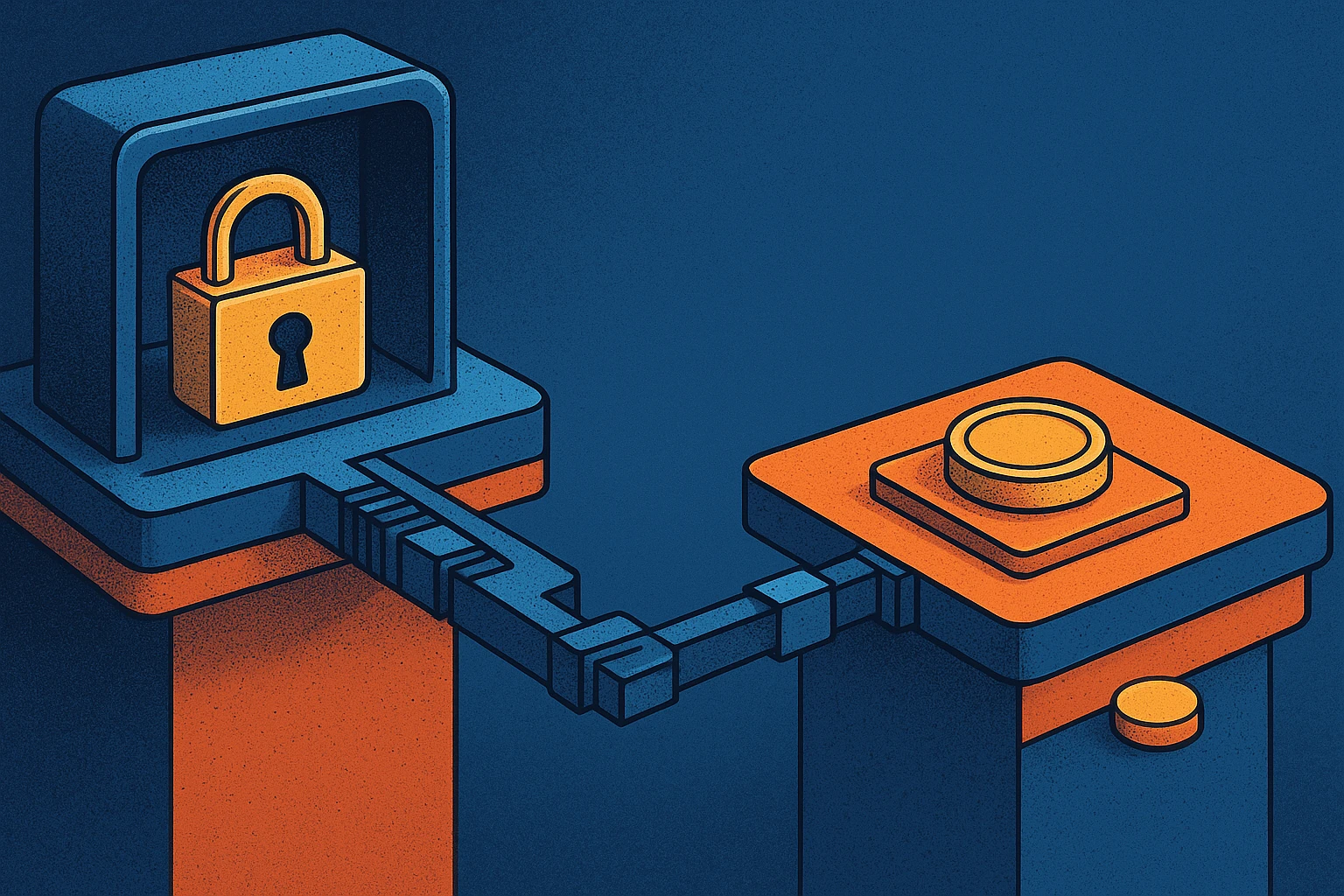
Bridge designs vary, so there is no single transfer mechanism. One common pattern is lock and mint. The user sends an asset to a contract or custodian on the source chain. After the transfer is recognized, a corresponding representation is issued on the destination chain. To return, the representation may be burned, after which the original asset is released on the source chain.
In this pattern, the destination token is often called a wrapped asset or bridged asset. It usually represents a claim connected to the original asset held or controlled elsewhere. It is not necessarily the original token on its native chain. Its usefulness depends on the bridge’s design, the backing or redemption process, and whether people and applications on the destination chain accept it.
Other bridges use liquidity pools. Instead of locking a specific user’s asset and minting a matching representation, a service may take one supported asset and pay out an equivalent asset from liquidity available on the destination chain. The assets involved may have different technical forms, and the payout can depend on pool balances, fees and the bridge’s rules. A route can be unavailable or less favorable when the needed liquidity is limited.
Bridges also need a way to establish that something happened on the source chain. Depending on the design, this may involve validators, external observers, cryptographic proofs, contracts, or a combination of mechanisms. A relayer may pass a message between networks, but passing the message is not itself proof that every bridge design is secure. The important question is how the destination system decides that the source transaction is valid and who or what can influence that decision.
Wrapped assets are not all the same
A wrapped token can have the same ticker or approximate market value as an asset on another chain while being a different token contract. Its name alone does not establish who issued it, what backs it, or how it can be redeemed. Multiple bridges can create different representations of the same underlying asset on the same destination network. Applications may support one version and reject another.
Before using a bridged asset, check its exact contract address and the network on which it exists. Confirm that the application you intend to use supports that specific asset, not just a familiar ticker. If the asset is meant to be redeemable for a native token, look for clear information about the redemption process and its conditions. A representation may be useful without being identical to the native asset in transferability, liquidity or accepted uses.
In decentralized finance, a wrapped asset may be deposited into a lending market, liquidity pool or other smart contract. That introduces additional dependencies: the bridge, the token contract, the DeFi application, and sometimes other protocols used by that application. A problem in one part can affect the value or usability of the whole position. A token accepted by a DeFi interface is not thereby guaranteed to be safe or redeemable.
What can go wrong
Contract and control risks
Many bridges rely on software that holds assets, issues representations or authorizes releases. A coding error, flawed assumption or exploit in a contract can lead to loss, stuck funds or unauthorized token creation. A bridge may also depend on keys, validators or other parties that approve cross-chain messages. If those controls fail or are compromised, the destination chain might accept an action that should not have been accepted.
Some systems can be paused, upgraded or administered by designated parties. Those powers may help respond to a problem, but they also mean that users depend on the system’s control arrangements. Read the bridge’s documentation for its main security assumptions, pause or upgrade mechanisms, and any stated limits. A security review or audit can provide useful information, but it cannot prove that software is free of defects or prevent every operational failure.
Delays and incomplete transfers
A transfer can take longer than expected because the source transaction needs confirmations, the chain is congested, a bridge message is waiting to be processed, destination-chain activity is delayed, or a service is performing additional checks. Some systems also use queues or rely on human operations. The time shown by a wallet or interface may be an estimate, not a guarantee.
It helps to distinguish the stages. A source transaction can be submitted but not yet confirmed. It can be confirmed while the bridge message is still pending. The destination transaction can then be submitted but not yet confirmed. A transaction hash on one chain does not necessarily mean the destination asset has arrived. Use the bridge’s official status tools and the relevant block explorers to check each stage, rather than repeating the transfer simply because the first screen has not updated.
If a transfer appears stuck, avoid sending another transaction until you understand its status and the bridge’s recovery instructions. Resubmitting may create a second transfer or additional fees. Never share a seed phrase or private key with someone offering to “fix” a pending bridge transaction. Legitimate recovery steps should not require handing over control of your wallet.
Fees, liquidity and changing outcomes
A cross-chain transfer may involve a source-chain transaction fee, a bridge fee, a destination-chain fee and, depending on the design, a swap or liquidity cost. You may also need the destination chain’s native token to pay for later actions, even if the bridged asset itself arrived successfully. Review the estimated amount received and the fees before confirming, and leave room for the destination costs you expect to incur.
Liquidity-based routes can have limits or changing quotes. A route that is available at the start may become unavailable before completion, and a quoted amount can differ from the final amount under the service’s rules. Slippage settings and minimum-received conditions may matter for routes that swap assets. Understand whether the operation is a simple transfer, a transfer plus swap, or a deposit into an application; these are not the same action.
Check the destination before you send
Destination-chain checks are essential because a successful source transaction does not guarantee that the result will be useful where it arrives. Before confirming, verify the following details:
- Network: Confirm the exact destination chain selected in the bridge and in your wallet. A familiar address format does not prove that the destination network is correct.
- Recipient: Check that the destination address is one you control or an address supported by the receiving service. Exchanges may require a particular network and may not accept every bridged token.
- Asset: Confirm the token contract or asset version you expect to receive, not only its ticker or display name.
- Amount and route: Review the estimated amount, fees, minimum received, and whether a swap or other application action is included.
- Gas: Check how you will pay for a later transaction on the destination chain. Receiving a token without the chain’s required fee asset can leave you unable to move it immediately.
When checking addresses or token details, use information from the bridge or application’s verified documentation and compare it with the wallet or block explorer. Be wary of search results, unsolicited messages and copied links that imitate a service. A small test transfer can help reveal a setup mistake, but it still incurs fees and does not establish that a bridge is secure.
Custody, spot assets and derivatives
Using a bridge from a self-custody wallet means you control the wallet keys, but you still rely on the bridge’s contracts or operators for the cross-chain process. Self-custody does not eliminate smart-contract risk. With a custodial exchange transfer, the exchange controls the assets while they are held there; its internal balance is not the same as a wallet balance recorded on a public chain.
A spot token is an asset held or recorded on a blockchain or by a custodian. A derivative, such as a futures contract, is a separate agreement whose value is linked to an asset; it is not the same as bridging that asset. Moving a token through a bridge does not transfer a derivatives position, and a derivatives platform may not support the bridged token at all. Likewise, using a token in DeFi adds application-specific risks beyond simply holding it.
For readers comparing crypto services or managing wallet activity, GlobeGain’s educational material can help clarify general concepts, but a bridge’s own documentation and current transaction details are the key sources for understanding a particular route. Check what is actually being transferred, which party or contract controls it, and what you will receive on the destination chain.
A practical way to think about bridge risk
Before using a bridge, consider the complete chain of dependencies: the source network, the bridge’s message and custody design, the destination network, the token representation, and any application you plan to use afterward. Ask what happens if one stage is delayed, paused or unavailable, and whether the asset can be redeemed through a documented process. Avoid treating a familiar token name, a completed source transaction or a displayed estimate as proof that every stage is settled.
Risk reminder: Cross-chain transfers can be delayed, misdirected or permanently lost because of user error, contract failures, compromised controls, liquidity limits or unsupported destination assets. Transactions may be difficult or impossible to reverse, and a wrapped asset may not be equivalent in practice to its native counterpart. Check the route, network, recipient, token and fees carefully, and only use funds you can afford to put at risk.