



- What execution latency means in practice
- Why latency affects the price you get
- Order routing: what happens after you click trade
- How market volatility changes the meaning of latency
- The difference between fast execution and reliable execution
- Why some traders care more than others
- What retail traders can realistically expect
- How traders can evaluate execution quality
- What traders can control and what they cannot
- A simple way to think about latency
- Risk reminder and final thoughts
- What execution latency means in practice
- Why latency affects the price you get
- Order routing: what happens after you click trade
- How market volatility changes the meaning of latency
- The difference between fast execution and reliable execution
- Why some traders care more than others
- What retail traders can realistically expect
- How traders can evaluate execution quality
- What traders can control and what they cannot
- A simple way to think about latency
- Risk reminder and final thoughts
What execution latency is and why it matters in Forex trading
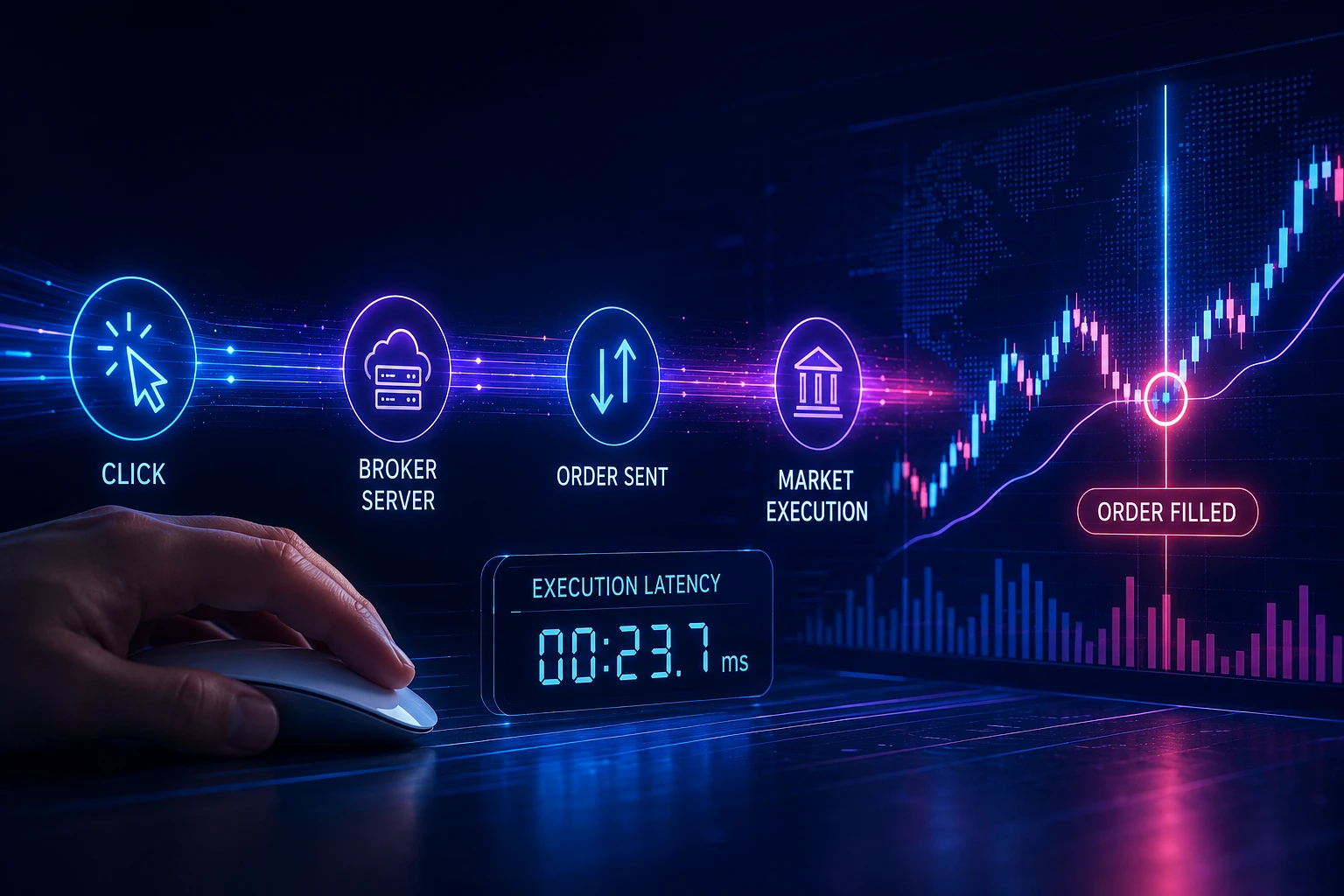


Execution latency is one of those trading terms that sounds technical, but it has a very practical meaning: it is the time between when you send an order and when that order is actually executed in the market. In Forex trading, that gap can be short enough to ignore in calm conditions, or long enough to change the price you receive during fast-moving periods.
For retail traders, execution latency matters because it affects how closely the filled price matches the price seen on the screen. It also matters when comparing brokers, account types, liquidity conditions, and even cashback offers through services such as GlobeGain, where the focus is often on the overall trading conditions rather than a single advertised feature. A low spread is useful, but if execution is slow or unstable, the total trading experience can still be poor.
This article explains what execution latency is, what influences it, how it interacts with market volatility and order routing, and what realistic expectations look like for everyday Forex and CFD traders.
What execution latency means in practice
When a trader clicks buy or sell, several things happen before the order is completed. The trading platform sends the instruction, the broker receives it, the broker’s systems process it, the order is routed to a liquidity source or internal execution venue, and the fill is returned to the platform. Execution latency is the time consumed by that chain.
It is important to separate latency from spread. Spread is the difference between bid and ask prices. Latency is the delay between order submission and execution. A trader can have a tight spread but still experience poor fills if execution is slow. Likewise, a broker may show a slightly wider spread but still provide fast and stable fills. The two should be assessed together.
Latency can appear in several forms:
- Network latency — the time data takes to travel between the trader’s device and the broker or server.
- Platform latency — the time the trading software needs to process the order request.
- Broker processing latency — the time used by back-end systems to check, route, and manage the order.
- Market execution latency — the time required to receive a fill from the liquidity source or market venue.
In daily trading, these delays are often measured in milliseconds or fractions of a second. That may sound tiny, but in liquid pairs during major news releases or volatile sessions, those fractions can matter.
Why latency affects the price you get
Forex prices move continuously. If the market stays still while your order travels, the fill may match what you expected. But if price moves during that travel time, the execution price may differ from the quote that triggered your order.
This difference can show up as slippage. Slippage is not always bad; sometimes a trader receives a better price than expected. But during fast markets, slippage often means the fill is worse than the visible quote. Latency increases the chance that the market will move before the order is completed, especially for market orders and other order types that seek immediate execution.
Latency is particularly noticeable when:
- the market is moving quickly after major economic news
- liquidity is thinner, such as around session transitions or late in the trading day
- volatility increases due to unexpected events
- the trader is using a strategy that depends on very small price differences
For a longer-term trader, a few milliseconds may not matter much. For a short-term scalper or someone trading around news, it can be much more important because the strategy depends on speed and precision.
Order routing: what happens after you click trade
Order routing is the process of moving an order from the trader to the execution venue. In simple terms, it is the path the order takes. That path may be direct or may involve several internal steps depending on the broker’s model, technology stack, and liquidity structure.
Some brokers send orders directly to external liquidity providers. Others may aggregate liquidity from multiple sources, then route orders based on price, size, and availability. In some cases, the order is processed through an internal system before reaching the market. Each extra step can add a small amount of delay.
Good routing is not only about speed. It is also about consistency and stability. A fast route that fails during high volatility is not a good route. A slightly slower route that remains dependable under stress can produce better trading conditions overall.
When comparing brokers, it helps to ask practical questions:
- How are orders processed during normal and high-volatility periods?
- Are orders routed to external liquidity sources or handled through an internal execution model?
- Is execution described as market execution, instant execution, or another model?
- Are there frequent requotes, rejects, or delays under load?
These questions matter more than promotional language. Traders often focus on spread and bonus-style offers, but execution quality can shape real trading outcomes far more than a marketing headline.
How market volatility changes the meaning of latency
Latency is not always equally important. Its impact depends heavily on market volatility. In a quiet market, a short delay may not change much. In a fast market, the same delay can result in a very different fill.
Volatility means price is moving more quickly and less predictably than usual. That increases the chance that the market will be at a different level by the time an order arrives. When volatility spikes, even a small delay can produce slippage, partial fills, or rejection in some trading environments.
Common situations that can increase volatility include:
- major economic releases such as central bank announcements or employment data
- unexpected geopolitical headlines
- session opens when liquidity changes sharply
- thin-market periods where fewer counterparties are available
For retail traders, this creates an important reality check: a quote displayed on the screen is not a promise. It is a snapshot. In a moving market, the displayed price can change before the trade is filled. Latency is part of why that happens.
The difference between fast execution and reliable execution
Many traders use the word “fast” as if it has a single meaning, but there are really two separate ideas: speed and reliability. Speed is the average time from order to fill. Reliability is how consistently the broker handles orders across different market conditions.
A broker can advertise very fast average execution but still perform poorly when markets become active. That is why it is more useful to think about execution quality as a combination of factors:
- Average speed — how quickly orders are normally filled
- Consistency — how much execution time varies
- Stability under stress — how the system behaves during volatility
- Fill quality — whether the fill price is close to the requested price
- Failure rate — how often orders are rejected or require retrying
Reliable execution is especially valuable for traders who place many orders, use stop orders, or trade short time frames. A consistently acceptable fill is often more useful than a very fast but unstable one.
Why some traders care more than others
Execution latency does not affect all strategies equally. Its importance depends on the trader’s horizon, style, and sensitivity to price differences.
Scalpers and very short-term traders
These traders usually care the most. Their strategies may rely on small price movements, so even modest slippage can overwhelm the intended edge. For them, low and stable latency is not a luxury; it is part of the strategy’s basic assumptions.
Intraday traders
Day traders still care about execution quality, especially around news or when using market orders, but they may be somewhat less sensitive than scalpers. Good execution helps avoid surprises and keeps trade management more predictable.
Swing traders
Swing traders often hold positions longer and may be less affected by milliseconds of delay. Even so, latency still matters during entries and exits if the market is moving quickly or if stops and limits are placed near current price.
Copy trading and automated systems
Automated strategies and copy trading can be sensitive to delay because signals, order transmission, and execution all happen in sequence. A small delay can create a mismatch between the original signal and the actual fill.
What retail traders can realistically expect
Retail traders sometimes expect execution to behave like a fixed-price checkout process. Forex does not work that way. The market is dynamic, and execution is a process rather than a guarantee of a particular screen price.
Realistic expectations include the following:
- Orders may be filled slightly better or worse than expected
- Slippage can occur, especially during volatility
- Execution times can vary by session and market conditions
- Different account types or liquidity conditions may produce different results
- What works well on a demo account may feel different on a live account
It is also important to remember that demo environments often do not fully reflect live market conditions. A demo may show smooth execution because it is not dealing with the same liquidity constraints, network variability, or volatility spikes that a live account faces. This is one reason real-world testing matters.
For traders comparing brokers, a useful mindset is to treat execution as one part of total trading cost. The total cost includes spread, commission where applicable, slippage, and the practical effect of delay. A broker or cashback arrangement may look attractive on paper, but the actual result depends on the quality of order handling as well as the pricing model.
How traders can evaluate execution quality
There is no single number that tells the whole story, but a trader can look for evidence of how execution behaves in practice.
- Test the same strategy in different market conditions. Compare quiet periods with more active periods to see whether execution remains stable.
- Observe slippage patterns. Occasional slippage is normal. A repeated pattern of poor fills deserves attention.
- Check order behavior. Look for delays, rejects, partial fills, or unexpected price jumps between order submission and fill.
- Review broker execution descriptions carefully. Terms such as market execution or instant execution have practical implications.
- Use a consistent setup. Device, internet quality, platform load, and server distance can all affect the experience.
When comparing conditions through a broker comparison or cashback service such as GlobeGain, it is sensible to look beyond the rebate and ask whether the underlying execution environment matches the trader’s style. A cashback arrangement may help offset trading costs, but it cannot repair weak order routing or poor fill quality.
What traders can control and what they cannot
Traders cannot control market volatility or force the market to stay still while an order is routed. They can, however, reduce avoidable sources of delay.
Things a trader can often improve include:
- using a stable internet connection
- avoiding unnecessary platform load and heavy multitasking
- choosing a server or account setup that is geographically and technically suitable
- understanding which order types are more sensitive to market movement
- not assuming that the cheapest-looking offer is the best overall execution environment
That said, traders should be cautious about promising themselves a perfect setup. Even a well-configured system cannot eliminate market movement. The goal is not zero latency; the goal is execution that is consistent enough for the strategy being used.
A simple way to think about latency
An easy analogy is to think of latency like the time between pressing a button and a car actually moving. If the road is empty, that delay barely matters. If traffic suddenly changes, the same delay can create a very different result.
In Forex, market volatility is the traffic. Order routing is the road. Execution latency is the time lost along the way. When all three are calm and efficient, fills tend to be smoother. When the market becomes busy, even small delays can have a visible effect.
Risk reminder and final thoughts
Execution latency is not a minor technical detail reserved for professional traders. It is part of the real trading experience for anyone buying or selling Forex or CFDs. It affects fill quality, slippage, and how well a trading approach performs under changing market conditions.
The key lesson is to evaluate execution in context. Consider volatility, order routing, account type, and the total cost of trading. Do not assume that a lower spread or a cashback offer automatically means better practical conditions. And do not expect live trading to behave like a static quote screen.
Risk reminder: Forex and CFD trading involve significant risk of loss and may not be suitable for all investors. Execution quality can help manage trading frictions, but it cannot remove market risk, and past execution experience does not guarantee future results.
For traders comparing brokers, the best approach is to look for clear, stable, and realistic execution conditions that fit the trading style being used. That is usually more valuable than chasing the smallest number on a marketing page.