



- What Is Drawdown in Trading?
- What Is Static Drawdown?
- What Is Trailing Drawdown?
- Static Drawdown vs Trailing Drawdown: The Main Difference
- Example of Static Drawdown
- Example of Trailing Drawdown
- Why Prop Firms Use Different Drawdown Models
- Advantages of Static Drawdown
- Disadvantages of Static Drawdown
- Advantages of Trailing Drawdown
- Disadvantages of Trailing Drawdown
- Which Drawdown Model Is Better?
- How Static Drawdown Affects Trading Behavior
- How Trailing Drawdown Affects Trading Behavior
- Balance-Based vs Equity-Based Trailing Drawdown
- Common Mistakes Traders Make with Drawdown Rules
- How to Trade Safely Under Static Drawdown
- How to Trade Safely Under Trailing Drawdown
- Why Beginners Often Struggle More with Trailing Drawdown
- Static Drawdown vs Trailing Drawdown in Simple Terms
- What Traders Should Check Before Joining a Prop Firm
- Final Thoughts
- FAQ: Static Drawdown vs Trailing Drawdown
- What Is Drawdown in Trading?
- What Is Static Drawdown?
- What Is Trailing Drawdown?
- Static Drawdown vs Trailing Drawdown: The Main Difference
- Example of Static Drawdown
- Example of Trailing Drawdown
- Why Prop Firms Use Different Drawdown Models
- Advantages of Static Drawdown
- Disadvantages of Static Drawdown
- Advantages of Trailing Drawdown
- Disadvantages of Trailing Drawdown
- Which Drawdown Model Is Better?
- How Static Drawdown Affects Trading Behavior
- How Trailing Drawdown Affects Trading Behavior
- Balance-Based vs Equity-Based Trailing Drawdown
- Common Mistakes Traders Make with Drawdown Rules
- How to Trade Safely Under Static Drawdown
- How to Trade Safely Under Trailing Drawdown
- Why Beginners Often Struggle More with Trailing Drawdown
- Static Drawdown vs Trailing Drawdown in Simple Terms
- What Traders Should Check Before Joining a Prop Firm
- Final Thoughts
- FAQ: Static Drawdown vs Trailing Drawdown
Static Drawdown vs Trailing Drawdown Explained


In prop trading, risk rules are just as important as trading strategy. Many traders spend a lot of time looking for better entries, indicators, and setups, but they fail challenges because they do not fully understand the firm’s drawdown model. Two of the most important concepts every trader should know are static drawdown and trailing drawdown.
At first glance, these terms may sound technical, but the difference between them is critical. A trader can perform well under one drawdown model and struggle badly under the other, even with the exact same strategy. That is why understanding static drawdown vs trailing drawdown is essential before joining a prop firm or trading a funded account.
In this guide, we will explain what static drawdown means, what trailing drawdown means, how each one works, why the difference matters, and which model may be better depending on your trading style.
What Is Drawdown in Trading?
Before comparing static drawdown and trailing drawdown, it is important to understand what drawdown means in general.
Drawdown is the reduction of account value from a reference point. In prop trading, drawdown rules are used to control risk and protect capital. If a trader loses too much money according to the firm’s rules, the account is breached.
In simple terms, drawdown tells you how much room you have to lose before you fail the account.
Every prop firm has its own version of drawdown rules, but most models are based on one of these two systems:
- Static drawdown
- Trailing drawdown
What Is Static Drawdown?
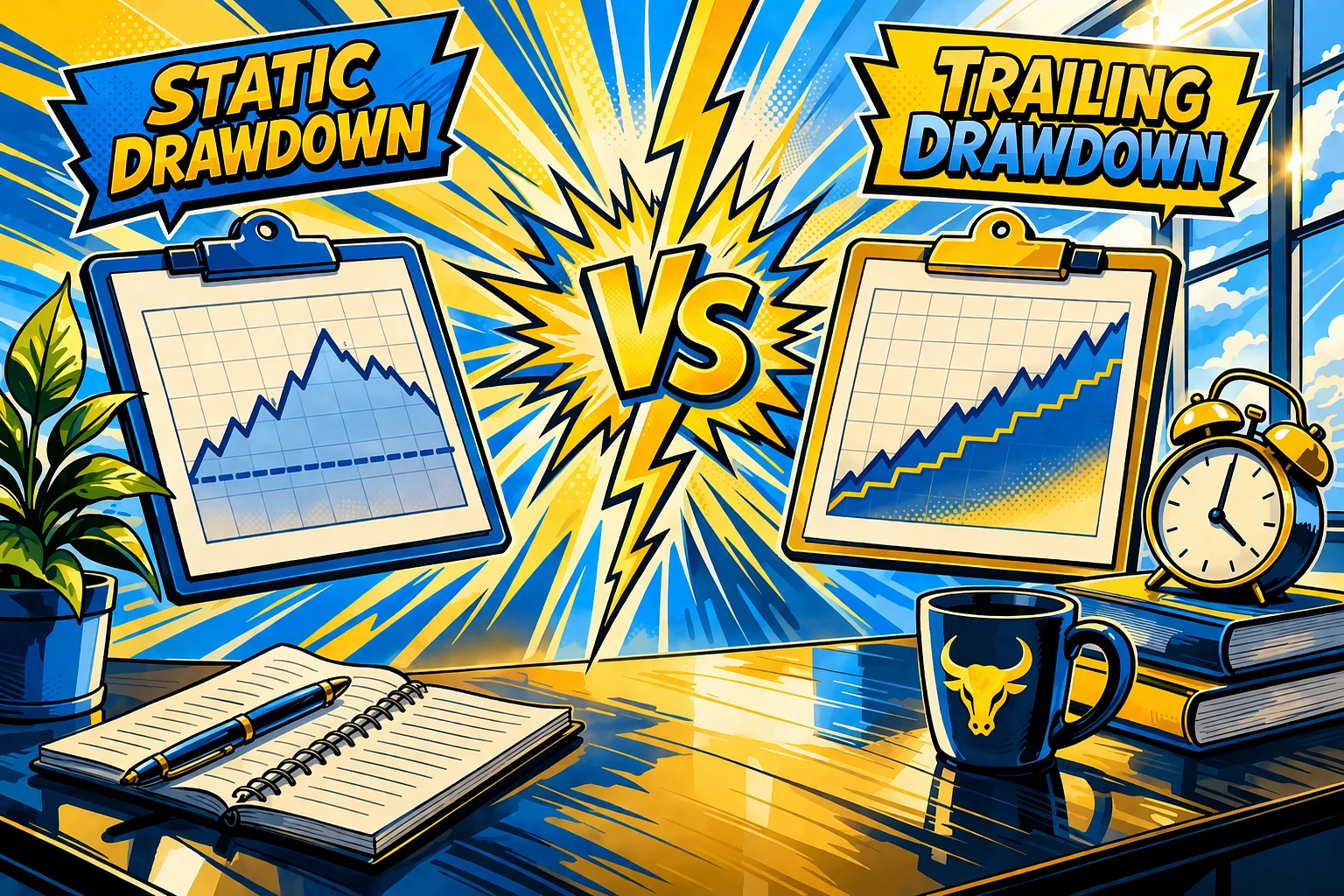
Static drawdown is a fixed maximum loss limit that does not move as the account grows. It stays at the same level from the beginning unless the firm applies a specific rule that changes it later.
For example, imagine a trader starts with a $100,000 account and the firm allows a static drawdown of $8,000. That means the account cannot fall below $92,000.
If the trader grows the account to $103,000, the drawdown level still remains at $92,000. If the account later drops from $103,000 to $92,500, the trader is still safe. The maximum loss threshold has not moved.
This is why static drawdown is generally considered easier to understand and more flexible for many trading styles.
Key feature of static drawdown
The loss limit stays fixed.
What Is Trailing Drawdown?
Trailing drawdown is a moving loss limit that follows the account upward as the balance or equity reaches new highs. Instead of staying fixed at one level, the allowed drawdown “trails” the account performance.
For example, suppose a trader starts with a $100,000 account and has a trailing drawdown of $8,000. At the start, the minimum allowed account level might be $92,000. If the trader grows the account to $102,000, the trailing threshold may move up to $94,000. If the trader reaches $105,000, the threshold may move up to $97,000.
This means the trader gains profit, but the safety line also rises. As a result, there is often less room to give back gains compared with a static model.
Key feature of trailing drawdown
The loss limit moves upward as the account reaches new highs.
Static Drawdown vs Trailing Drawdown: The Main Difference
The main difference is simple:
- Static drawdown stays fixed at one level
- Trailing drawdown moves up as the account grows
This difference may seem small, but in practice it changes how a trader must manage risk, profits, position sizing, and emotional pressure.
Under a static model, profits create more breathing room. Under a trailing model, profits may increase the account balance, but they may not increase flexibility in the same way because the drawdown threshold also rises.
Example of Static Drawdown
Let us look at a simple example.
Starting account: $50,000
Static drawdown: $2,500
Minimum account allowed: $47,500
Now suppose the trader performs as follows:
- Day 1: account rises to $50,800
- Day 2: account rises to $51,300
- Day 3: account falls to $49,200
The trader is still safe because the account remains above $47,500. The drawdown level never moved. Even though some profit was given back, the account is still within the rules.
This makes static drawdown easier for traders who experience natural swings in performance.
Example of Trailing Drawdown
Now let us look at a trailing example.
Starting account: $50,000
Trailing drawdown: $2,500
Initial minimum account allowed: $47,500
Now suppose the trader performs as follows:
- Day 1: account rises to $50,800
- Trailing threshold moves to $48,300
- Day 2: account rises to $51,300
- Trailing threshold moves to $48,800
- Day 3: account falls to $48,700
In this case, the trader may fail the account because the threshold had already moved up to $48,800. Even though the trader is still above the original $47,500 level, the account breaches the updated drawdown rule.
This example shows why trailing drawdown can feel more restrictive and more punishing if a trader gives back profits after reaching new highs.
Why Prop Firms Use Different Drawdown Models
Prop firms use drawdown rules to control risk and evaluate trader behavior. The drawdown model affects how the firm measures consistency, protects capital, and filters traders.
Static drawdown is often seen as more trader-friendly because it allows more flexibility after profits are made.
Trailing drawdown is often used to encourage tighter capital control. It rewards traders who can protect profits and avoid large pullbacks after reaching new highs.
From the firm’s perspective, trailing drawdown may help identify traders who manage risk more carefully. From the trader’s perspective, it can feel more difficult because the rules become tighter as success grows.
Advantages of Static Drawdown
1. Easier to Understand
Static drawdown is simple. The trader knows exactly where the failure level is from the beginning.
2. More Flexibility After Profits
When the account grows, the drawdown floor stays in the same place. This gives the trader more room to manage positions and survive natural fluctuations.
3. Better for Swings in Performance
Some strategies have normal profit pullbacks. Static drawdown gives more tolerance for that behavior.
4. Less Emotional Pressure
Because the risk line does not constantly move upward, the trader may feel less pressure about giving back part of a recent gain.
Disadvantages of Static Drawdown
1. Less Pressure to Lock In Gains
Some traders may become careless because the threshold stays fixed and does not force tighter protection of profits.
2. May Encourage Larger Givebacks
If a trader becomes too relaxed after making gains, they may allow profits to shrink significantly before adjusting behavior.
Advantages of Trailing Drawdown
1. Encourages Strong Risk Control
Trailing drawdown pushes traders to protect gains more carefully.
2. Promotes Consistency
Because the threshold rises with performance, traders are rewarded for smooth equity growth rather than large swings.
3. Forces Better Capital Preservation Habits
Traders must think more carefully about when to reduce risk, secure profits, or stop trading after a strong run.
Disadvantages of Trailing Drawdown
1. More Restrictive
Trailing drawdown reduces flexibility as the account reaches new highs.
2. Harder for Volatile Strategies
Strategies with deeper pullbacks may struggle under a trailing model, even if they are profitable overall.
3. Higher Emotional Pressure
Some traders feel stressed knowing that each new high also raises the failure threshold.
4. Easier to Breach After Good Performance
A trader can have several strong days and still fail by giving back too much profit afterward.
Which Drawdown Model Is Better?
There is no universal answer. The better model depends on the trader’s strategy, psychology, and risk style.
Static drawdown may be better for traders who:
- Need more flexibility
- Use strategies with natural pullbacks
- Prefer simpler rule structures
- Want more room to manage trades over time
Trailing drawdown may be better for traders who:
- Are highly disciplined with profit protection
- Trade with tight control and low volatility
- Prefer steady, smooth growth
- Can reduce risk quickly after strong gains
For many beginners, static drawdown is often easier to manage. For more experienced traders with strong control over risk, trailing drawdown can still be workable.
How Static Drawdown Affects Trading Behavior
Static drawdown often creates a more relaxed structure. Since the failure line stays fixed, a trader may feel more comfortable letting trades develop or continuing to follow the plan even after a profitable streak.
This can be positive when it supports patience and disciplined execution. However, it can become negative if the trader starts taking profits for granted and gives back too much because the account still has room.
The key with static drawdown is not to confuse flexibility with carelessness.
How Trailing Drawdown Affects Trading Behavior
Trailing drawdown usually creates a more defensive mindset. After a strong run, the trader knows the account has less room to fall before breaching the rules. That often leads to tighter trade selection, smaller risk, or a decision to stop trading temporarily and protect gains.
This can improve discipline, but it can also create fear. Some traders become overly cautious and stop taking good setups because they are afraid of giving back profits.
In this sense, trailing drawdown is not only a risk rule. It is also a psychological test.
Balance-Based vs Equity-Based Trailing Drawdown
Another important detail is that trailing drawdown may be calculated in different ways.
Balance-based trailing drawdown
This type moves upward only when trades are closed and profits are realized in the account balance.
Equity-based trailing drawdown
This type may move upward based on unrealized profit while a trade is still open. This can be more dangerous because the threshold may rise during an open trade, even if the position later reverses.
Equity-based trailing drawdown is generally considered more difficult than balance-based trailing drawdown. Traders should always check which model the firm uses.
Common Mistakes Traders Make with Drawdown Rules
1. Not Reading the Rulebook Carefully
Many traders assume they understand drawdown but miss important details about how it is calculated.
2. Confusing Profit with Safety
Under trailing drawdown, being in profit does not always mean the account is safe. The threshold may already have moved up.
3. Trading Too Aggressively After Gains
Some traders feel confident after a strong day and then take oversized risk the next day, only to lose the account.
4. Ignoring Open Equity Risk
If the firm uses equity-based rules, unrealized fluctuations matter just as much as closed results.
5. Choosing a Firm Based Only on Account Size
A large account is not useful if the drawdown model does not suit the trader’s style.
How to Trade Safely Under Static Drawdown
- Set your own internal drawdown tighter than the firm’s rule
- Avoid becoming careless after a profit streak
- Keep position sizing consistent
- Use stop losses and planned exits
- Track account performance daily
Even though static drawdown gives more room, it should still be treated with discipline.
How to Trade Safely Under Trailing Drawdown
- Monitor the trailing threshold constantly
- Reduce risk after reaching new highs
- Protect profits more actively
- Avoid large fluctuations in position size
- Be especially careful with open trades if the rule is equity-based
Under trailing drawdown, awareness is critical. Traders must always know exactly where the moving threshold stands.
Why Beginners Often Struggle More with Trailing Drawdown
Beginners often find trailing drawdown more difficult because they are still learning emotional control and consistency. A trailing rule punishes profit giveback more quickly, which can create frustration and confusion.
New traders may think they are doing well because the account is above the starting balance, but under a trailing model they can still be close to failure. This misunderstanding causes many avoidable breaches.
That is why beginners should pay close attention not only to account size, but also to the drawdown structure before choosing a prop firm.
Static Drawdown vs Trailing Drawdown in Simple Terms
If you want the simplest possible explanation, think of it like this:
Static drawdown is like having a floor that never moves.
Trailing drawdown is like having a floor that rises as you climb higher.
With a fixed floor, you keep more room as you move up. With a rising floor, the space under you becomes smaller if you fall back down.
What Traders Should Check Before Joining a Prop Firm
Before choosing a prop program, traders should ask:
- Is the drawdown static or trailing?
- Is the rule based on balance or equity?
- Does the trailing drawdown stop moving at a certain level?
- How much room is allowed daily and overall?
- Does this structure fit my strategy and psychology?
These questions are just as important as profit split, platform, or payout terms.
Final Thoughts
Understanding static drawdown vs trailing drawdown is essential for anyone involved in prop trading. These are not small technical details. They directly affect how much flexibility a trader has, how risk must be managed, and how psychologically demanding the account will feel.
Static drawdown is fixed, easier to understand, and generally more forgiving. Trailing drawdown moves upward with performance, encourages tighter profit protection, and is often more difficult to manage.
Neither model is automatically good or bad. The important thing is knowing how each one works and choosing the one that fits your trading style. A trader who ignores drawdown structure may fail even with a profitable strategy. A trader who understands it clearly has a much better chance of surviving, performing consistently, and keeping the account in good standing.
FAQ: Static Drawdown vs Trailing Drawdown
What is static drawdown?
Static drawdown is a fixed maximum loss limit that does not move as the account balance grows.
What is trailing drawdown?
Trailing drawdown is a moving loss limit that rises as the account reaches new highs.
Which is better: static or trailing drawdown?
It depends on the trader. Static drawdown is usually more flexible, while trailing drawdown requires tighter control of profits and risk.
Why is trailing drawdown harder?
It is harder because the threshold moves upward with profits, so giving back gains can lead to account failure faster.
Is static drawdown better for beginners?
For many beginners, yes. Static drawdown is usually easier to understand and gives more room for normal account fluctuations.