



Normal liquidity returns — ISM, euro inflation, and the big NFP finale
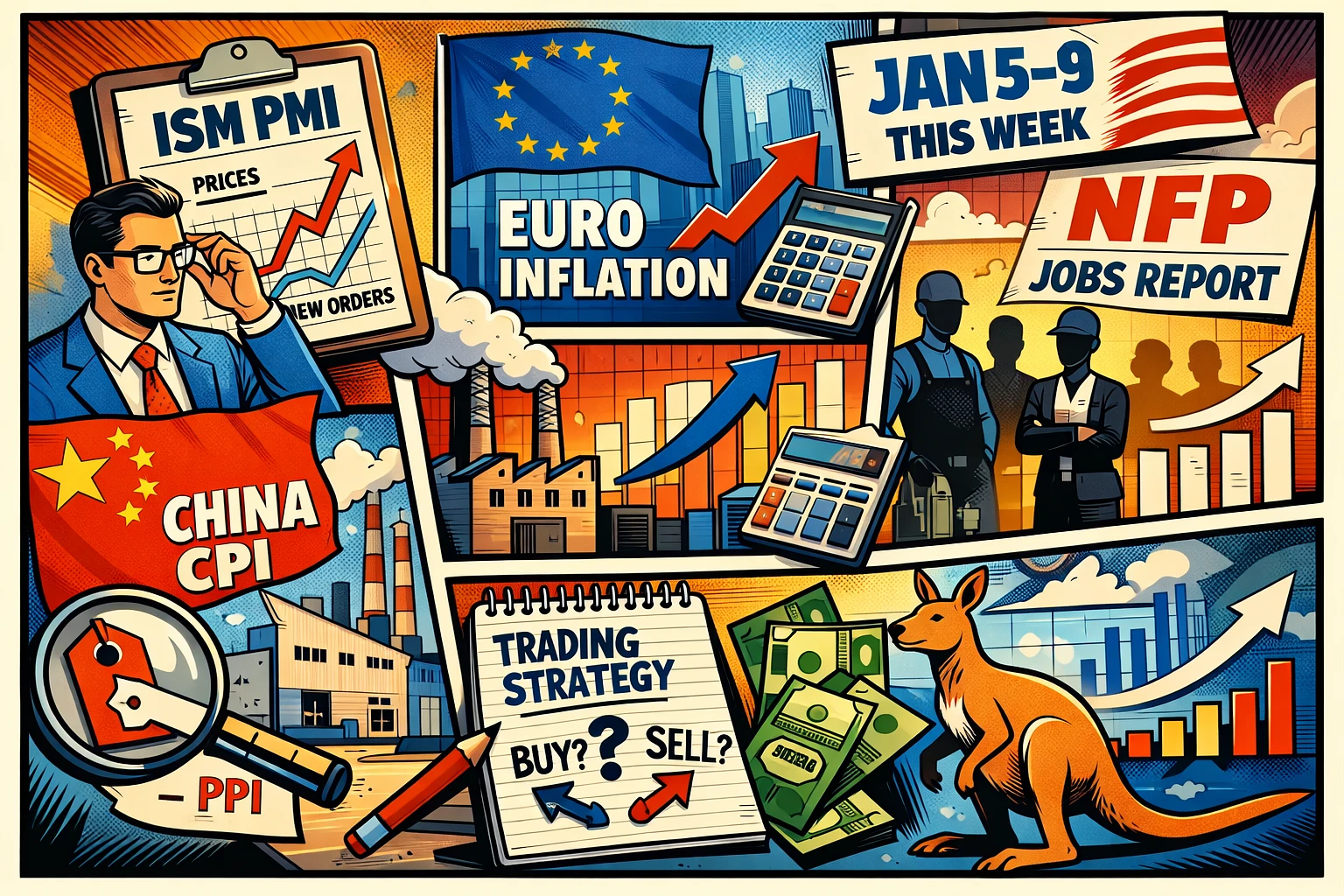


The first full week of the year is usually a “volume week”: liquidity comes back, positioning gets rebuilt, and rate expectations get repriced fast. This one has a clean structure. Early-week ISM sets the tone for US growth and yields; Europe delivers key inflation signals via Germany’s HICP and the euro area flash CPI; and Friday wraps it all up with US Non-Farm Payrolls.
Asia adds a useful tail risk: China CPI/PPI hits before the US jobs report, which can nudge risk appetite and commodity-linked FX (especially AUD) right as traders set up for the main event.
Below is a day-by-day map of the catalysts, the FX pairs likely in play, and a few example scenarios. All times are in GMT. Trade ideas are provided for educational purposes only and are not individual investment advice.
Monday, January 5
US: ISM Manufacturing PMI (December)
Time: 15:00 GMT
In focus: USD/JPY, EUR/USD, gold, US indices
The week’s first heavyweight print. Don’t just watch the headline — the market often reacts harder to Prices Paid and New Orders, because those feed directly into the “yields + USD” loop.
- Stronger ISM + sticky prices: USD and yields typically bid; gold and risk can wobble.
- Weaker ISM: yields can slip and the dollar may soften, particularly versus JPY and EUR.
Key zones (USD/JPY)
Early January often amplifies USD/JPY’s sensitivity to US surprises. As rough reference zones, traders tend to respect resistance near 157.80–158.50 and demand around 156.00–156.30. Validate with the actual swing highs/lows on your live chart.
Example trade idea
- Scenario: ISM beats and Prices Paid stays elevated.
- Entry: consider USD/JPY longs after a clean hold above nearby resistance (e.g., above 157.80).
- Stop: below the breakout area (guide: 157.10), allowing for headline volatility.
- Targets: 158.30–158.50 first, then reassess with yields.
Tuesday, January 6
Germany: HICP flash estimate (December)
Time: typically European morning
In focus: EUR/USD, EUR/JPY, German rates
Germany often acts as the “lead indicator” for the euro area inflation narrative. A firmer-than-expected HICP print can quickly harden ECB pricing — and support the euro.
US: S&P Global Final Services PMI (December)
Time: 14:45 GMT
A lighter day overall — good for technical positioning ahead of Wednesday’s multi-release cluster and Friday’s jobs report.
Key zones (EUR/USD)
EUR/USD often treats 1.1700 as a balance line and 1.1800 as the “momentum gate.” Failure to hold 1.1700 increases the odds of a drift toward 1.1600.
Wednesday, January 7
Euro area: Flash CPI / Core CPI (December)
Time: 10:00 GMT
In focus: EUR/USD, EUR/GBP, European rates
The week’s main European release. The core measure is the market’s pressure point: a sticky core print can slow the market’s pace of ECB easing expectations and give the euro a clean boost.
US: ADP, ISM Services, JOLTS, Factory Orders
Time: 13:15 GMT (ADP), 15:00 GMT (ISM Services / JOLTS / Factory Orders)
In focus: EUR/USD, USD/JPY, gold, US indices
Wednesday is the dress rehearsal for NFP. ISM Services matters most: services dominate the US cycle. Expect a “two-step” market at times — the first move on thin liquidity and algos, then the second move once the macro story is stitched together.
Example trade idea (EUR/USD)
- Scenario: euro area inflation surprises higher while ISM Services disappoints.
- Entry: look for EUR/USD longs if price holds above the balance zone (e.g., 1.1700) and pushes toward 1.1800.
- Stop: below nearby support (guide: 1.1680) if price snaps back under the level.
- Targets: 1.1800 first, then 1.1860–1.1900 if momentum persists.
Thursday, January 8
US: Jobless claims, trade balance, productivity & unit labor costs
Time: 13:30 GMT
In focus: USD, gold, US indices
This is the final “calibration set” before NFP. Unit labor costs can be especially market-moving if they shift the inflation narrative in either direction.
Key zones (AUD/USD)
AUD/USD often becomes a proxy for “risk + USD” during NFP weeks. As a rough framework, 0.6650–0.6700 can act as resistance and 0.6550–0.6580 as support — but confirm with current structure and volatility.
Friday, January 9
China: CPI and PPI (December)
Time: 01:30 GMT
In focus: AUD/USD, USD/CNH, commodities
China inflation prints can swing stimulus expectations and risk sentiment. Weak data can be a mixed signal: it may increase policy support hopes but also highlight demand softness — so the reaction often depends on the prevailing mood.
US: Non-Farm Payrolls, unemployment rate, average hourly earnings
Time: 13:30 GMT
In focus: all USD pairs, gold, US indices
The week’s centerpiece. Don’t trade the headline alone — wages and the unemployment rate frequently drive the second, more durable move. Revisions also matter. The first minutes can be extremely spiky; decide in advance where you simply don’t want to be positioned.
Canada: employment report
Time: 13:30 GMT
In focus: USD/CAD, CAD/JPY
Canada prints at the same time as NFP, which can turn USD/CAD into a noise machine. Often the market reacts to the US first, then reassesses Canada once the dust settles.
US: University of Michigan consumer sentiment (prelim.)
Time: 15:00 GMT
This release sometimes decides whether the post-NFP trend holds into the weekly close.
How to trade the week without unnecessary damage
1) Wednesday and Friday do the heavy lifting
- Wednesday: euro inflation + ISM Services can reshape rate pricing on both sides of the Atlantic.
- Friday: NFP often sets the market’s tone for the next 1–2 weeks.
2) Trade the “reaction to the reaction”
The first move is often liquidity-driven. For many strategies, waiting for the initial burst to fade and then trading the retest of a clear level is calmer — and frequently more consistent.
3) NFP risk rules: smaller is better
With US and Canada reporting simultaneously at 13:30 GMT, spreads and slippage can jump. Reduce size, avoid averaging against momentum, and keep your invalidation point clear.
Disclaimer
This material is for information and education only and is not individual investment advice. Always use risk controls and adapt scenarios to your own account size and tolerance.