



- Understand what an address and network do
- Start with the recipient’s deposit or receive instructions
- Verify the address, not just its beginning and end
- Match the network on both sides
- Include memo, tag, and other required fields
- Use a test transfer thoughtfully
- Make the transfer in a deliberate sequence
- What irreversibility means—and what to do after an error
- Keep the transfer type in perspective
- Risk reminder
- Understand what an address and network do
- Start with the recipient’s deposit or receive instructions
- Verify the address, not just its beginning and end
- Match the network on both sides
- Include memo, tag, and other required fields
- Use a test transfer thoughtfully
- Make the transfer in a deliberate sequence
- What irreversibility means—and what to do after an error
- Keep the transfer type in perspective
- Risk reminder
How to Check a Wallet Address and Network Before Sending Crypto
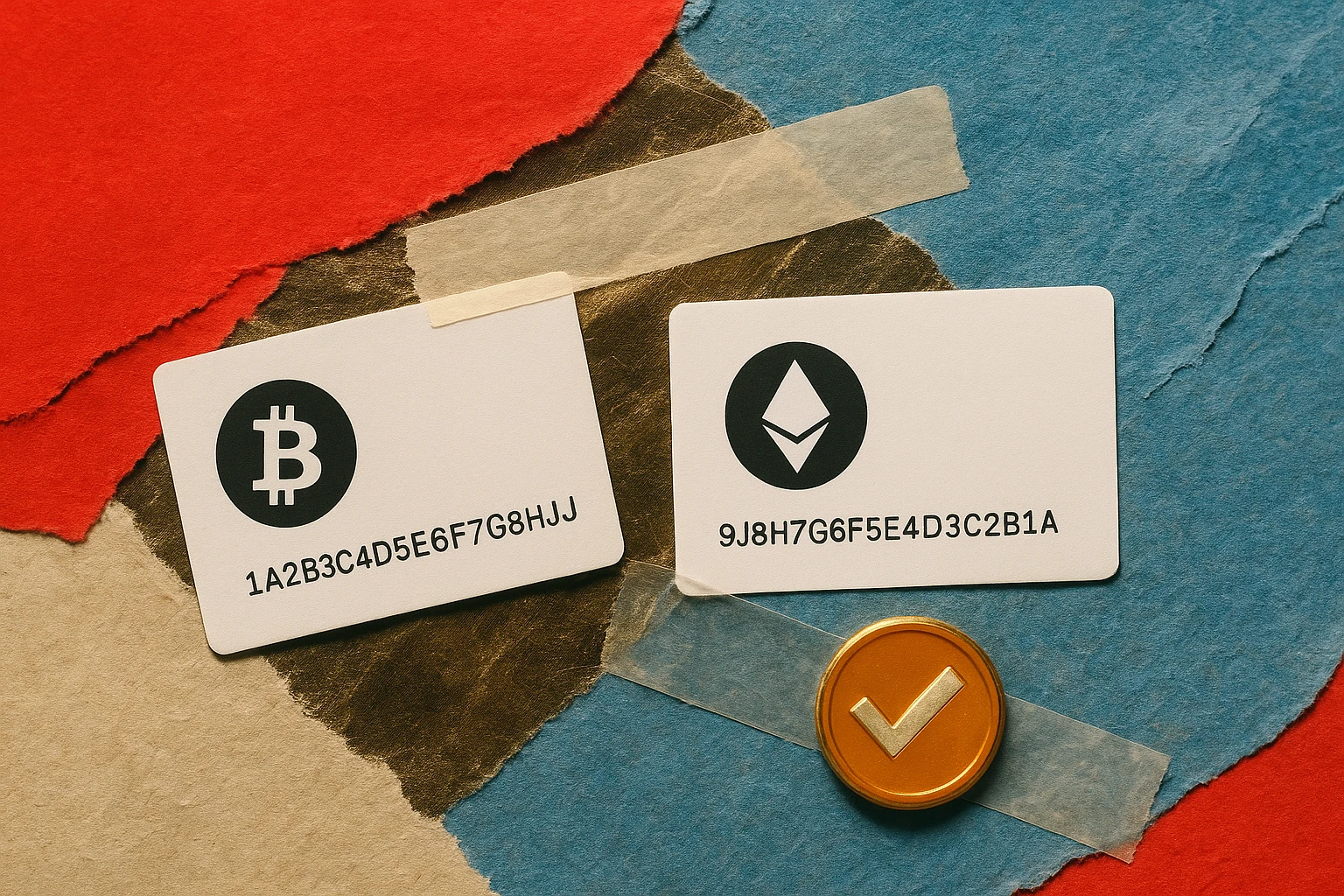


Before sending cryptocurrency, verify two separate things: the destination address and the network used to deliver the asset. A correct address on the wrong network may not reach the intended account, while a correct network paired with a mistyped address can send funds somewhere you cannot access. Many blockchain transactions cannot be cancelled once broadcast and confirmed. A careful check before pressing Send is therefore part of using crypto safely, not just an administrative step.
The safest process is to get the receiving instructions from the destination itself, compare the complete address and network, check any required memo or tag, and consider a small test transfer when appropriate. A test can reveal some problems, but it does not guarantee that a larger transfer will succeed. The details below explain what to check and what the checks can—and cannot—prove.
Understand what an address and network do
A wallet address is a destination identifier on a blockchain. It may belong to a self-custody wallet controlled by private keys, or it may be an address managed by a company such as a crypto exchange. The address alone does not always tell you which asset or network a recipient supports. In some cases, addresses on different networks look similar or even use the same format.
A network, also called a blockchain or chain, is the system that records and processes a transaction. Bitcoin, Ethereum, and other networks have different transaction rules. Some assets are also available on multiple networks. For example, a token may exist as a token on Ethereum and as a separately issued or bridged representation on another chain. Sending one version does not automatically convert it into another.
Think of an asset transfer as having several linked details: the asset, the network, the destination address, and—where required—a memo or tag. All applicable details must agree with the recipient’s instructions. A wallet displaying a familiar token name does not by itself establish that a receiving exchange accepts that token on the network you selected.
Start with the recipient’s deposit or receive instructions
If you are sending to an exchange, sign in through its official app or website and open the deposit page for the specific asset. Select the network from the options shown there, then read the instructions on that page. Do not rely on an old screenshot, a search result, a message from someone else, or an address saved for a previous deposit. An exchange can change which networks it supports, and deposit details may differ between assets.
For a self-custody wallet, use the wallet’s receive function and choose the correct asset or network if the wallet offers that choice. If the recipient has given you an address, confirm the network and asset with them through a trusted communication channel. A wallet may support several networks without supporting every token on each one.
Before copying anything, check for deposit conditions such as a minimum amount, confirmation requirements, a temporary deposit suspension, or a required memo, destination tag, or payment ID. These instructions are operational details that affect whether a deposit is credited. If the destination service says a memo is mandatory, treat it as part of the destination information rather than an optional note.
Verify the address, not just its beginning and end
Copy and paste addresses whenever possible instead of typing them by hand. Then compare the pasted address with the source, ideally character by character. For a long address, a wallet may show only its beginning and end in a summary. Open the full details before approving the transaction and check the complete value where the interface permits it.
Copying reduces typing errors but creates its own risk: malicious software can replace a copied address with a different one. After pasting, compare the address in the sending screen against the address displayed by the trusted recipient source. Do not assume that matching first and last characters prove the middle is correct. Some clipboard malware deliberately substitutes an address that looks similar.
Address checksums can help detect certain typing mistakes in formats that support them, but they do not prove that an address belongs to the person or service you intend to pay. A valid-looking address can still be the wrong address. Likewise, a QR code is only a convenient way to encode destination information; it does not make the destination trustworthy. If you scan one, inspect the decoded address and network in the wallet before sending.
For a new or high-value recipient, confirm the address through a second trusted route. For example, compare the wallet’s receive screen with information obtained directly from the recipient, rather than relying solely on an address sent in an unexpected message. Be wary of support impersonators and unsolicited requests to “verify” a wallet by sending funds. Never share a recovery phrase or private key to confirm an address.
Match the network on both sides
On the sending side, select the exact network named in the recipient’s deposit or receive instructions. Names can be confusing: a service may use a formal chain name, a common abbreviation, or a label that distinguishes a network from another with a similar name. Read the full label and any explanatory note; do not choose based only on a familiar token ticker or a lower displayed fee.
Then check that the recipient accepts the asset on that network. The fact that the sender’s wallet offers a network option does not mean the receiving exchange supports deposits there. Exchanges typically credit assets only when they arrive through supported routes and meet their deposit requirements. If the network is unsupported, the transfer may not appear in your account. Recovery, when possible, may require the recipient’s cooperation and may not be available.
Some address formats are used across multiple chains. That can make a mismatched transfer look deceptively plausible: the address may pass a basic format check even though the recipient’s deposit system does not monitor or credit that network. Other networks use distinct address formats, but visual differences are not a reliable substitute for reading the instructions.
Also distinguish native assets from tokens. A network’s native coin is used to pay transaction fees on that network, while tokens are assets recorded under that network’s rules. A token with the same ticker on two chains may represent different contracts or versions. If a wallet or service offers several similarly named assets, verify the exact asset and network rather than assuming the ticker settles the question.
Include memo, tag, and other required fields
Some receiving systems use one shared deposit address for many customers and rely on an additional identifier to assign incoming funds to the right account. Depending on the network or service, that identifier may be called a memo, destination tag, payment ID, or something similar. If the deposit page supplies one, copy it into the matching field in the sending wallet. An address can be correct while a missing or incorrect identifier prevents automatic crediting.
Do not put a memo into the address field, or an address into the memo field. If the sending wallet does not show a field that appears necessary, stop and check the wallet’s instructions or contact the recipient through its official support channel before proceeding. Do not invent an identifier or assume that a blank field is acceptable when the recipient says otherwise.
Use a test transfer thoughtfully
For a new recipient, a small test transfer can confirm that the selected route reaches the expected destination and that any required deposit details were entered correctly. Wait for the transfer to meet the relevant confirmation conditions and check that the funds appear in the intended account or wallet before sending the remainder. Do not judge success solely by seeing a transaction in a wallet history; verify receipt at the actual destination.
A test transfer has limits. It costs a network fee, and an exchange may enforce a minimum deposit or may not credit amounts below a stated threshold. A tiny deposit can therefore fail to appear even when the address and network are otherwise correct. If a minimum applies, follow the service’s instructions rather than sending an amount too small to qualify.
A successful test is useful evidence, not a guarantee. It confirms only that the tested amount, asset, address, network, and any included identifier worked at that time. It cannot guarantee future availability, prevent a later mistake when you change a field, or ensure that the recipient’s deposit service will remain operational. Recheck the details for the main transfer instead of assuming they are unchanged.
Make the transfer in a deliberate sequence
Open the recipient’s current receive or deposit instructions and identify the exact asset and supported network.
Copy the destination address from that trusted source. Copy any required memo or tag separately.
In the sending wallet or exchange, choose the same asset and network. Confirm that the destination supports deposits through that route.
Paste the address and any identifier into the correct fields. Compare the full address against the source and inspect the network label again.
Review the amount, fee, and any minimum or confirmation conditions. Make sure the amount is being sent from the intended account or wallet.
For an unfamiliar destination, consider a suitable test transfer. Confirm its receipt before repeating the process for a larger amount.
After submitting, save the transaction ID and check its status through the sending wallet or a suitable block explorer. For an exchange deposit, also check the exchange’s deposit history and allow for its stated processing requirements.
When a wallet displays a final confirmation screen, use it as a last review rather than treating it as a formality. Check the destination and network again. If anything differs from the instructions, cancel before signing or broadcasting and investigate the discrepancy.
What irreversibility means—and what to do after an error
Once a transaction is confirmed on a blockchain, the sender generally cannot reverse it by asking the network to refund the funds. A transfer to an incorrect address may be unrecoverable if no one controls that address or its owner will not return the assets. Sending through an unsupported network can also leave funds inaccessible from the recipient’s normal deposit interface.
“Irreversible” does not mean every mistake is automatically lost. In some situations, a recipient may control the address or have a recovery process, but recovery depends on the specific network, wallet, and service. It may be unavailable, take time, or involve costs. Do not pay an unofficial recovery agent or give anyone your recovery phrase. Contact the recipient’s official support team promptly, provide the transaction ID and relevant details, and follow only verified instructions. Never send another payment merely because a stranger claims it is required to unlock or recover the first one.
Keep the transfer type in perspective
These checks concern moving on-chain assets; they are not the same as placing a trade. In spot trading, a user buys or sells an asset, which may remain in an exchange’s custody until withdrawn. A withdrawal then requires address and network checks. With self-custody, the user controls the keys and must protect them, while still verifying every outgoing destination.
Derivatives such as futures are contracts whose value is linked to an underlying asset; they are not necessarily a transfer of that asset to a wallet. DeFi applications may ask a user to connect a wallet and approve a transaction or token allowance. Those actions can create different risks from sending a deposit to an exchange. Read what a transaction will do, and verify the application and network, rather than assuming every wallet confirmation is a simple payment.
Risk reminder
Crypto transfers carry a risk of permanent loss from incorrect addresses, incompatible networks, missing identifiers, scams, or service and wallet issues. A test transfer and careful review reduce some errors but cannot eliminate risk or guarantee recovery. Send only after independently checking the current instructions and understanding what the wallet is asking you to authorize.