



- What a seed phrase actually is
- Why backup quality matters more than backup presence
- Offline storage reduces exposure, but it is not enough by itself
- Phishing is one of the easiest ways recovery fails
- Why recovery can fail even with the correct words
- Custody differences shape recovery outcomes
- Safe testing is part of backup discipline
- Where users usually lose access
- Practical habits that improve recovery odds
- Why this matters before large transfers
- Risk reminder
- What a seed phrase actually is
- Why backup quality matters more than backup presence
- Offline storage reduces exposure, but it is not enough by itself
- Phishing is one of the easiest ways recovery fails
- Why recovery can fail even with the correct words
- Custody differences shape recovery outcomes
- Safe testing is part of backup discipline
- Where users usually lose access
- Practical habits that improve recovery odds
- Why this matters before large transfers
- Risk reminder
How Seed Phrases Work and Where Wallet Recovery Can Fail
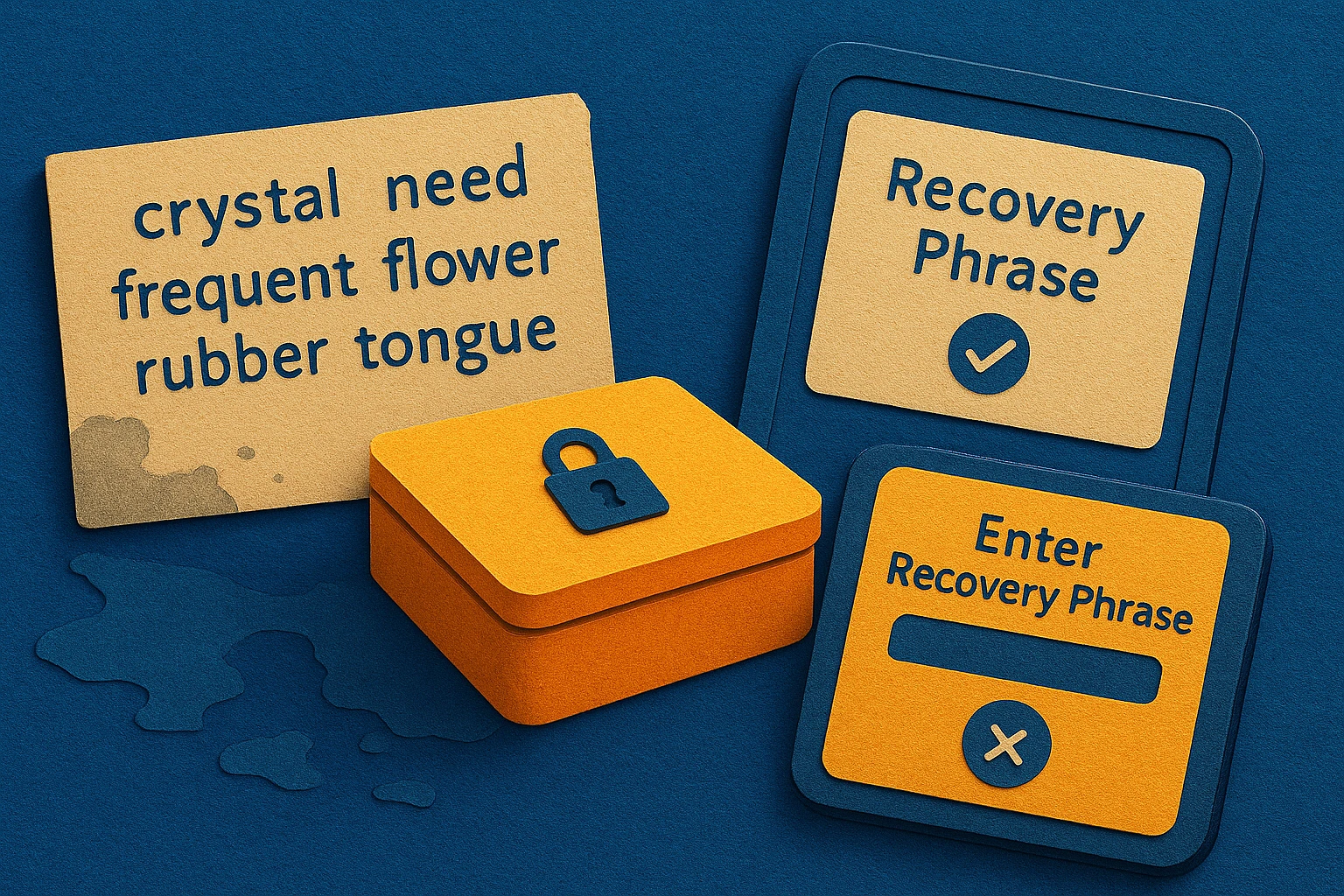


A seed phrase is the emergency key to many self-custody crypto wallets, but it is not magic, and it does not rescue every kind of loss. It is a human-readable backup that can recreate the private keys behind a wallet, yet recovery fails when the phrase is copied wrong, stored badly, exposed to phishing, or used with the wrong wallet setup. Understanding where it works and where it does not is essential for anyone holding spot assets, using DeFi, or managing crypto outside an exchange.
This matters because crypto custody is not one thing. On an exchange account, the platform typically controls the wallet infrastructure and recovery process. In a self-custody wallet, you control the backup and the risk. In DeFi, there may be no support desk at all, only the rules of the protocol and the keys you hold. If you trade derivatives through a venue, the account may still be recoverable through that provider, but the crypto collateral or withdrawal address can depend on separate wallets and separate backups. Seed phrases sit at the center of that divide.
What a seed phrase actually is
A seed phrase is usually a list of 12, 18, or 24 words generated by a wallet. Those words encode a master secret used to derive many private keys and addresses. In practice, one backup can recreate a whole wallet tree, including multiple receiving addresses and, depending on the wallet design, associated accounts derived from that same seed.
The important point is that a seed phrase is not the same thing as your username, password, email, or two-factor authentication code. Those may protect access to a service, but the seed phrase is often what recreates the keys themselves. If someone gets the phrase, they may be able to restore the wallet elsewhere and move the assets without needing your device.
That is why seed phrases are treated as the last line of recovery for self-custody spot holdings and many DeFi wallets. The phrase is not a support ticket. It is the backup of the cryptographic root.
Why backup quality matters more than backup presence
People often think the main risk is not having a backup at all. In reality, many recoveries fail because the backup exists but cannot be used correctly when needed.
Common backup failures
- Wrong words: one misspelled, swapped, or omitted word can make the phrase useless.
- Wrong order: the words must be entered in the exact sequence generated by the wallet.
- Partial copies: a note with only some words is often not enough.
- Unreadable storage: faded ink, damaged paper, water exposure, or corrupted digital notes can destroy the backup.
- Hidden dependency mistakes: some wallets also require a passphrase or use a particular derivation path; the seed phrase alone may not restore the same visible accounts.
A backup is only useful if you can later read it, trust it, and use it in the correct wallet setup. A phrase written down on paper is not automatically safe if the paper is stored where it can be photographed, lost, burned, or discarded during a move.
Offline storage reduces exposure, but it is not enough by itself
Storing a seed phrase offline is better than keeping it in an email draft, cloud note, screenshot, password manager, or chat app. Offline storage limits remote theft. But offline does not mean secure in all circumstances.
There are two different questions: can the phrase be stolen, and can it be recovered by you later? A backup that avoids hackers may still fail if it is not legible after years of storage, or if only one person knows where it is and that person becomes unavailable.
Better offline practices
- Write the full phrase exactly as shown by the wallet.
- Verify spelling and order immediately.
- Store it in a location that is physically protected from water, heat, and casual discovery.
- Consider more than one secure copy if loss is a realistic risk.
- Keep the backup separate from the device used for daily crypto activity.
Even when a backup is offline, access can still fail if the owner cannot find it in time or if family members do not know it exists. For long-term self-custody, the hardest problem is not writing the phrase down; it is designing a recovery plan that survives the passage of time.
Phishing is one of the easiest ways recovery fails
Phishing does not require breaking the cryptography. It only requires convincing a user to type the seed phrase into the wrong place. Fake support pages, fake wallet apps, fake browser pop-ups, and impersonation messages all exploit the same mistake: entering a recovery phrase where only trusted wallet software should ever see it.
A real wallet recovery happens inside software you installed intentionally, from a source you verified, and only when you already expect to restore a wallet. A scam recovery page often creates urgency, claims there is an account problem, or asks you to “synchronize,” “verify,” or “unlock” by entering the phrase.
In self-custody, the rule is simple: a seed phrase should be used only to restore access in trusted wallet software, never to “confirm identity” for anyone else. No legitimate exchange, DeFi project, airdrop claim, or support agent needs your seed phrase. If anyone asks for it, the safest assumption is that it is a theft attempt.
Why recovery can fail even with the correct words
It surprises many users that entering the exact phrase does not always show the same wallet balance they remember. That can happen for several reasons.
1. The wallet used a passphrase or extra secret
Some wallets allow an additional passphrase, sometimes called the 25th word, though it is not literally part of the standard word list. Without that extra secret, restoring the seed phrase may open a different wallet. To the user, it can look like recovery failed, when in fact the backup was incomplete.
2. The wallet derives accounts differently
Different wallet apps may present addresses in different orders or use different derivation paths for certain networks. The seed phrase can be valid, but the app may not display the same accounts the user expects unless the right wallet type or network settings are chosen.
3. The assets were not held in the wallet you think they were
For spot assets on an exchange, the exchange wallet and your account history are separate from a self-custody seed phrase. If a user sent funds to a centralized platform, the phrase from a personal wallet will not restore those exchange-held assets. Likewise, assets bridged into DeFi protocols may depend on smart contract positions, not only on the wallet address.
4. The wallet was only the access point, not the asset itself
In DeFi, some positions represent deposits, lending claims, liquidity shares, or collateralized exposure. Restoring the wallet lets you sign again, but it does not automatically undo liquidations, protocol failures, or smart contract losses. The seed phrase restores control over the address, not a guarantee of getting the same balance back.
Custody differences shape recovery outcomes
Anyone learning crypto should distinguish between custody models before assuming a recovery plan.
Exchange custody
On a centralized exchange, the platform generally manages key custody, and account recovery may depend on login credentials, identity verification, or support procedures. A seed phrase usually is not part of ordinary exchange account recovery. If funds are on the exchange, the main risk is losing account access, platform failure, or withdrawal restrictions, not forgetting a wallet phrase.
Self-custody spot wallets
For a personal wallet holding spot assets, the seed phrase is often the main recovery method. Lose it, and recovery may be impossible. Share it, and someone else may move the assets. This is the most direct example of “you own the keys, you own the responsibility.”
Derivatives platforms and margin accounts
With derivatives, the account can be separate from the wallet used to fund it. Even if a deposit wallet is recoverable, the trading account may still depend on the venue’s own controls. The seed phrase may help you restore the funding wallet, but it does not guarantee access to open positions, account history, or exchange-side balances.
DeFi wallets
In DeFi, the wallet is usually the signing identity. If the phrase is lost, you may lose the ability to move tokens, claim rewards, or manage positions. If the phrase is stolen, a thief may be able to interact with protocols from your address, subject to whatever permissions and approvals already exist.
Safe testing is part of backup discipline
Many people are told to back up their seed phrase, but not told to test recovery. A backup that has never been checked can fail at the worst possible moment. Testing should be done carefully and safely, without exposing the real phrase to risky environments.
How to test without creating extra risk
- Confirm the phrase on a trusted wallet app you already use.
- Use an offline or isolated environment when possible, and never type the phrase into random websites.
- Verify that the restored wallet matches the expected address before sending meaningful funds.
- Check whether any passphrase, account index, or network setting is required.
- Make sure the test does not overwrite your only backup or create confusion between multiple wallets.
Testing is especially important after changing phones, migrating devices, or switching wallet software. A phrase that restores correctly on one app may still display assets differently on another. The goal is not merely to see words accepted on a screen. The goal is to prove that you can recover the wallet you think you are protecting.
Where users usually lose access
Lost access is often a chain of smaller mistakes rather than one dramatic event.
- They stored the phrase digitally and the device was compromised.
- They wrote it down but later could not read their own handwriting.
- They remembered the wrong wallet app or the wrong account type.
- They used a passphrase and forgot that it existed.
- They assumed a support team could restore a self-custody wallet.
- They mistook exchange login recovery for wallet recovery.
These failures are common because crypto tools can look simple on the surface while hiding strict technical requirements underneath. The phrase is only one piece of the recovery chain. The app, the derivation method, the passphrase, and the asset location all matter.
Practical habits that improve recovery odds
Good recovery planning is not about making backups complicated. It is about making them boring, durable, and hard to misuse.
- Write the phrase once, carefully, from the original source.
- Keep the backup offline and private.
- Store at least one copy where environmental damage is less likely.
- Document any extra passphrase or wallet-specific recovery detail separately and securely.
- Use trusted wallet software only for restoration.
- Test recovery before placing all funds at risk.
If you use multiple wallets for different purposes, keep them clearly separated. For example, a long-term spot storage wallet, a DeFi interaction wallet, and a trading wallet should not all rely on the same operational assumptions. Segmentation reduces the damage from one mistake.
Why this matters before large transfers
Before sending a meaningful amount of crypto anywhere, it is worth asking a recovery question: if this device disappears, do I know exactly how to restore access? If the answer is no, the transfer is not ready.
That question matters for both newcomers and experienced users. A trader may know how to manage leverage on an exchange but still neglect a wallet backup. A DeFi user may understand on-chain approvals but forget that a phrase stored in a phone note is a weak defense. A long-term holder may believe offline storage is enough and never test whether the backup is actually usable.
GlobeGain readers often compare exchanges, wallets, and DeFi tools from a risk perspective. Seed phrase management is one of the clearest examples of how custody choices change the real risk profile. The best setup is not the one that sounds safest. It is the one you can recover correctly under stress.
Risk reminder
Crypto recovery is unforgiving: if a seed phrase is stolen, lost, or incomplete, access may be permanently gone. Never type your seed phrase into websites, chats, or support forms, and test recovery only in trusted wallet software before relying on it for real funds.